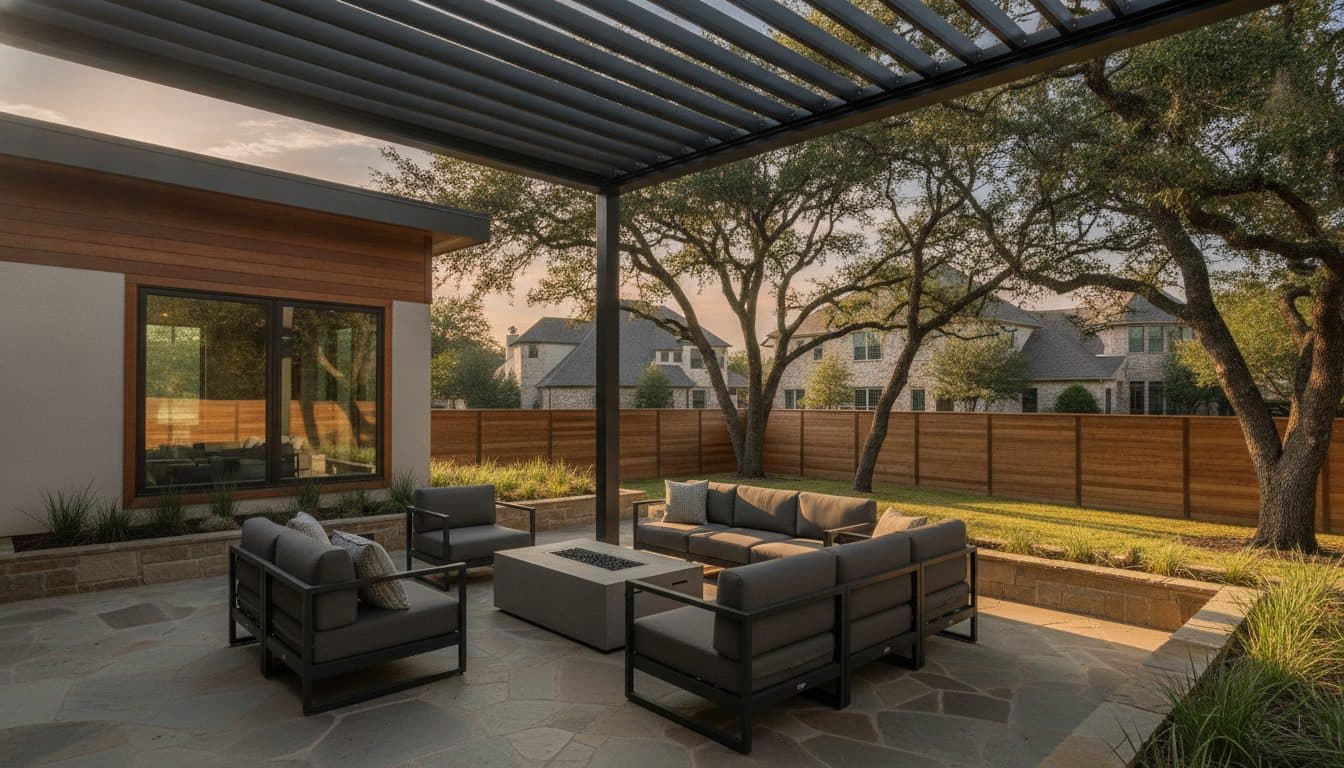
Wood & Steel Pergolas in Austin, Texas.
Traditional wood and engineered steel shade pergolas, sized and anchored for Texas wind.
An open pergola catches wind the way a sail does, and Central Texas hands out plenty of it, from gusty spring fronts to summer storm outflow. That makes anchoring the whole game. On Hill Country lots the ground under the topsoil is often limestone shelf or hardpan caliche, so we size the posts and footings to the actual substrate and engineer the structure to stand up to Texas wind rather than lean into it.
We build traditional cedar pergolas and engineered steel-shade structures, both scaled to throw real shade rather than a token lattice. Cedar suits homeowners who want a warm, natural overhead; steel spans farther with slimmer members and takes the heat and wind without movement. Either one is detailed to break the low western sun that makes an unshaded patio unusable by late afternoon.
Austin questions
It depends on what is under the surface. Where we hit limestone shelf, posts are anchored into the rock; where the lot is caliche or clay, we set footings sized to reach stable, load-bearing ground. The point is that anchoring is engineered to the specific site, because a pergola that is not properly footed becomes a wind problem.
Cedar gives the warm, traditional look and works well for shorter spans; engineered steel carries longer spans with slimmer members and holds its line against heat and wind without the movement wood shows over time. Both are anchored for local wind, so the choice is mostly about span, look, and upkeep.
A fixed pergola throws partial, patterned shade that softens the sun rather than blocking it entirely, and we can tighten the rafter and slat spacing to cut more of the low western glare. For full on-demand shade, a motorized louvered roof is the step up; a wood or steel pergola is the choice when the open, architectural look is the goal.
Get your instant estimate
Rather talk through it? (737) 312-2224