Steel-Framed WUI Decks
Fire-rated, steel-framed decks for Wildland-Urban Interface zones — the uncontested category in the Hill Country, and our specialty.
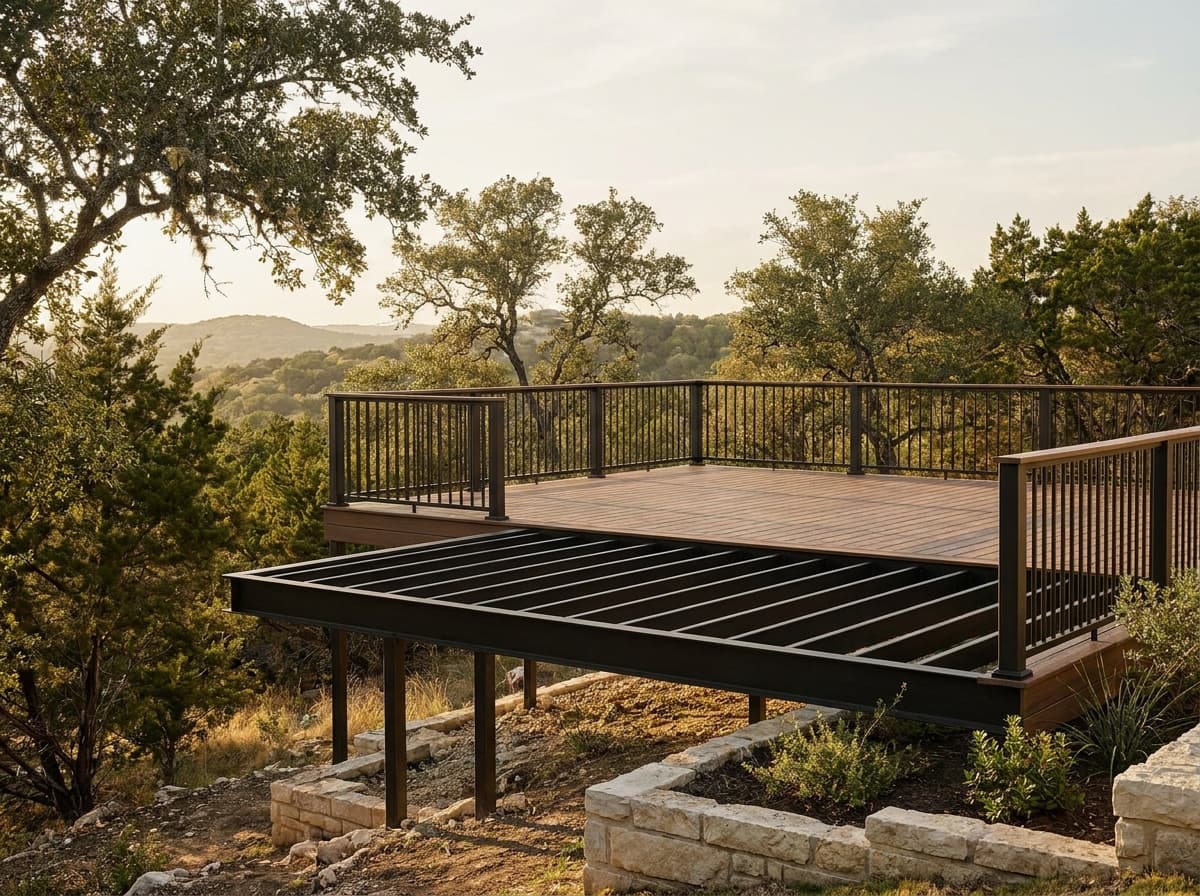
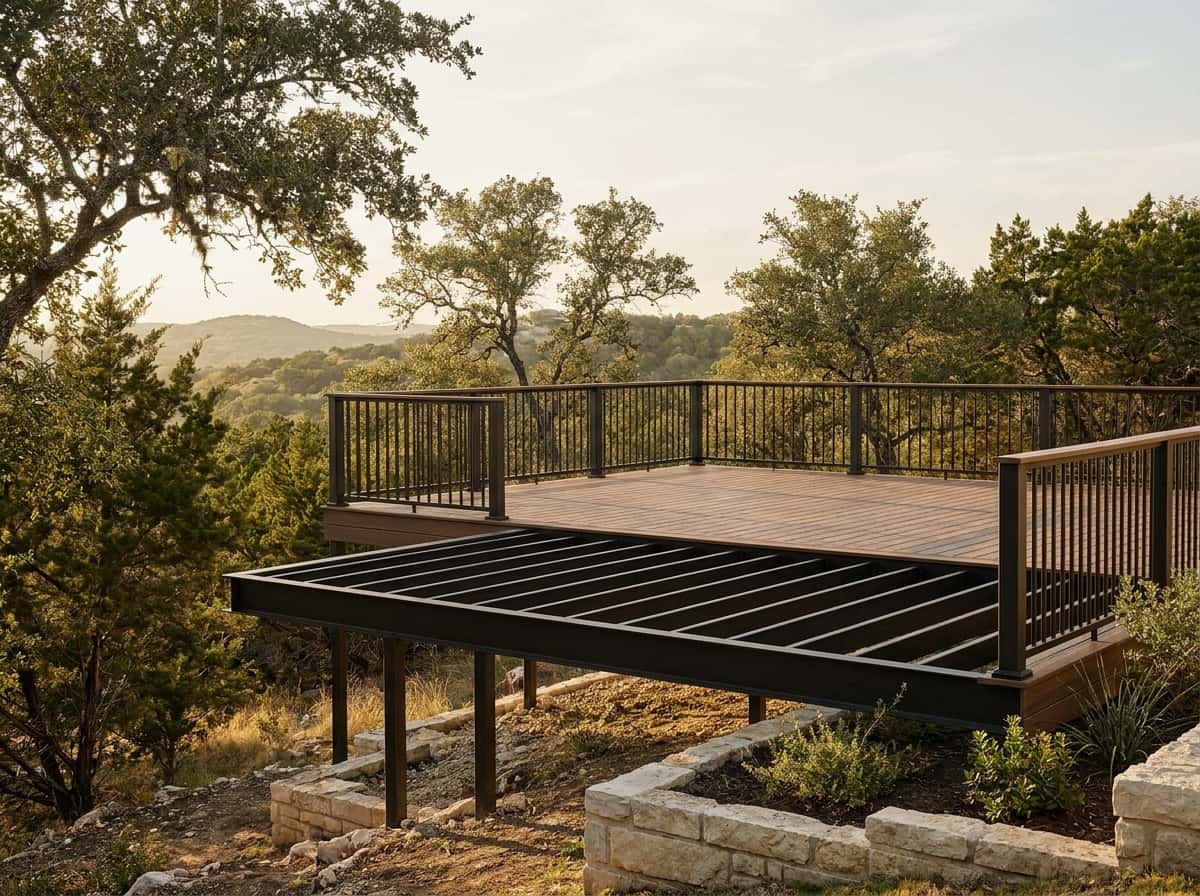
A steel-framed deck replaces the wood joists and beams under your deck with galvanized or coated steel. Steel does not burn, rot, warp, twist, or feed termites, so the structure stays dead-flat and dimensionally stable for the life of the deck — which is why it pairs so well with a capped composite surface that also refuses to move. In the Texas Hill Country there is a second, bigger reason: steel is non-combustible, and that matters for homes in or near wildland-urban interface (WUI) zones.
A WUI zone is where homes meet undeveloped wildland — the cedar, brush, and grass that can carry a wildfire. In those fires it is usually windblown embers, not the flame front itself, that ignite a house, and a wood deck is a classic ignition point: dry boards, gaps that catch embers, framing that feeds a fire once it starts. A fire-rated deck assembly answers that with non-combustible framing, ignition-resistant decking, and detailing that keeps embers out from underneath. XPRT specializes in these builds — we engineer the steel structure, spec the assembly, pull the permit, and install as one crew.
What a WUI zone is and who needs this
Wildland-urban interface is the term for the edge where development meets wild vegetation that can burn. Much of the Hill Country west and southwest of Austin sits in or near it, with homes tucked against cedar breaks, brush, and steep grassed slopes. The danger in a wildfire there is less the wall of flame and more the ember shower it throws ahead of itself, sometimes landing on a house well before the fire arrives.
You should consider a steel-framed, fire-rated deck if your lot backs up to that kind of wildland, if a local jurisdiction or your insurer asks for ignition-resistant construction, or if you simply want to remove the wood deck as an ignition point on a high-risk property. Not every home needs one, and we will tell you honestly whether your site is the kind that warrants it.
How a fire-rated deck assembly works
There is no single product that makes a deck safe from wildfire — it is the assembly that does the work. Non-combustible steel framing removes the fuel from the structure, ignition-resistant composite decking replaces the dry wood surface that embers usually catch, and careful detailing closes the gaps and undersides where embers otherwise lodge and smolder.
The goal is to deny embers the easy ignition points a conventional wood deck hands them. No responsible builder will call a deck fireproof — nothing outdoors is — but a properly specified assembly meaningfully reduces the risk that a wood deck introduces, and it is the standard we build to on WUI lots. We spec the whole assembly to the site and the applicable code rather than swapping in one part and calling it done.
Why steel framing lasts
Even setting fire aside, steel is the most stable substructure you can put under a deck. It does not rot in our wet-then-dry cycles, it does not warp or twist as it dries, and termites have nothing to eat. That dimensional stability is exactly what a capped composite surface wants underneath it — a frame that stays flat keeps the boards flat.
Steel also spans farther and carries more with less bulk than wood, which is a real advantage on the elevated, sloped, and hillside lots common in the Hill Country. Where a wood-framed deck would need more posts and heavier members, a steel frame can reach cleanly, giving you a stronger, longer-lived structure on exactly the terrain where these decks tend to be built.
Common questions
Wildland-urban interface describes the area where homes and development meet undeveloped wildland vegetation that can carry a wildfire. Much of the Hill Country around Austin falls in or near it. The primary danger to homes there is windblown embers, which is what a fire-rated deck assembly is designed to resist.
Not every home does. It makes the most sense when your lot is in or near a WUI zone, when a local jurisdiction or your insurer calls for ignition-resistant construction, or when you want the durability of a non-combustible, rot-proof frame. We assess your site and give you an honest read on whether it is warranted.
No. Steel is also the most dimensionally stable substructure available: it does not rot, warp, twist, or feed termites, so it stays flat under a composite surface and spans well on elevated, sloped lots. Many homeowners choose it for that durability alone, with the wildfire resistance as an added benefit.
There is no such thing as a fireproof deck outdoors. Ignition-resistant composite over non-combustible steel framing, with the gaps and undersides detailed to keep embers out, greatly reduces the ignition risk a conventional wood deck carries. Safety comes from the whole assembly working together, not from any single component.
Steel-Framed WUI Decks in the portfolio
See all →