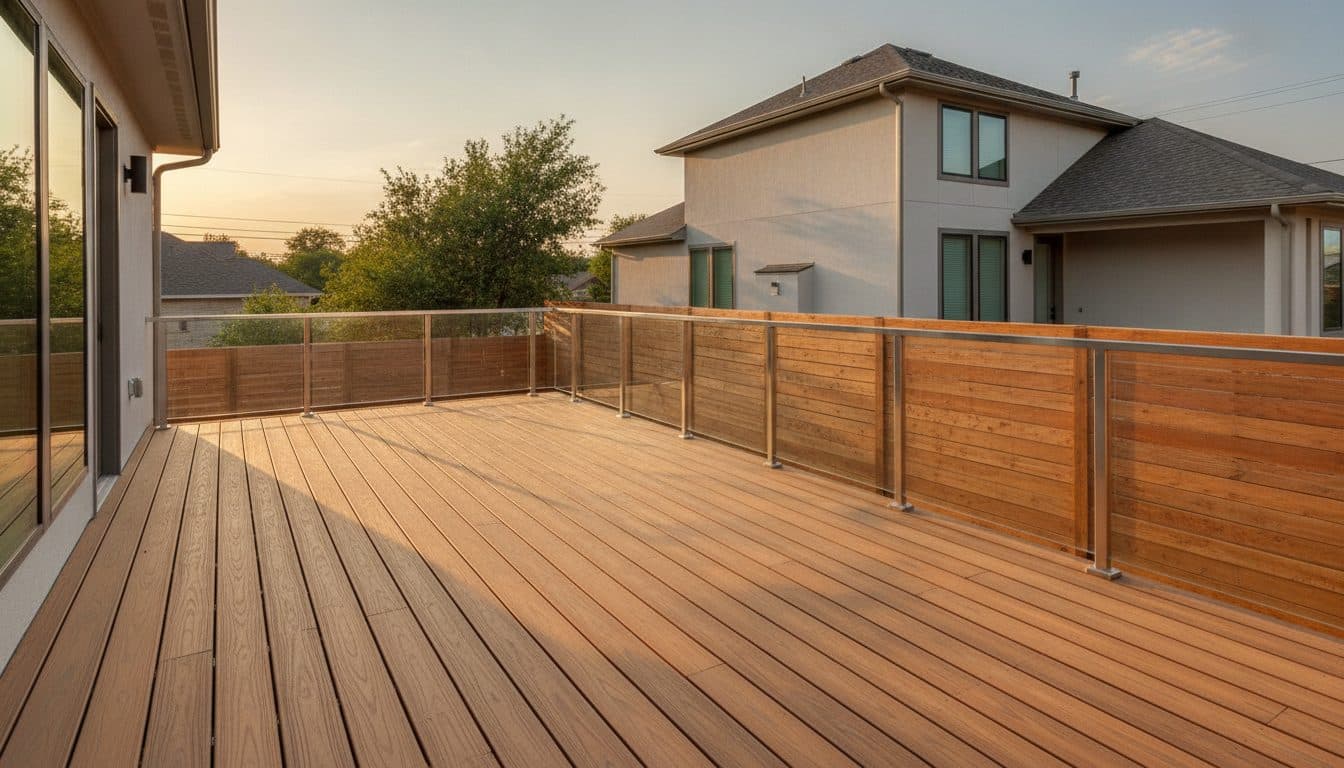
Frameless Glass Railing Cost in Central Texas (2026 Builder's Guide)
Frameless glass railing is the premium end of the railing ladder, and we quote it individually rather than post a per-foot price, because the engineering and hardware that make it safe are custom to each job. To set expectations honestly, it helps to see the whole ladder: a pressure-treated wood rail runs about $65 per linear foot, mid-range aluminum, cable, and metal rails run about $90 to $155 per linear foot, and premium composite rails run about $165 to $185 per linear foot. Frameless glass sits above all of them.
This guide places frameless glass on that ladder so you have honest reference points, explains why building code and structural engineering are what drive its cost, and is clear about what an installed job includes. If you want an exact number, the answer is a site quote, and this page explains why that is the honest way to price it rather than a dodge.
Why we quote frameless glass instead of listing a per-foot price
Most railing types have a stable per-foot rate because they are catalog systems built the same way every time. Frameless glass is not. Each run is engineered to its own span, load, and mounting condition, and the glass thickness, the base shoe or standoff hardware, and the fabrication all follow from that engineering. Two jobs of the same length can carry different glass and different hardware, and therefore different prices.
So rather than publish a single number that would be wrong more often than right, we measure the site, work out what the code and the span require, and quote it. That is the honest way to price a structural glass guard. What we can do in a guide is show you where glass lands relative to the rest of the railing ladder, so the quote arrives without sticker shock.
Where glass sits on the railing price ladder
The catalog railing ladder gives you real anchors. At the bottom, a pressure-treated wood rail is about $65 per linear foot. The mid-range spans about $90 to $155 per linear foot and covers black aluminum at around $90, cable rail and metal systems in the $120 to $150 range, and even a plexiglass panel rail around $155. The premium composite rails, Trex Transcend and Signature, sit at about $165 to $185 per linear foot.
Frameless tempered glass sits above that premium composite rate. It is worth drawing the line between a plexiglass panel and true frameless glass: the plexiglass option near the top of the mid-range is a lighter, framed panel, while frameless glass is a structural safety-glass guard with concealed or minimal hardware. They look related from a distance and are quite different products in cost, longevity, and clarity.
What engineering and code add
A railing is a guard, and building code treats a guard as a life-safety element. It has to resist a concentrated load pushing on the top rail and a distributed load along its length, which for a frameless system means the glass itself is doing structural work rather than just filling a frame. That drives the use of tempered, and often laminated, safety glass sized in thickness to the span and the load, which is why the engineering comes first and the price follows from it.
The hardware carries the rest of the cost. A frameless run is held by a continuous base shoe or a series of standoffs, typically in stainless steel for corrosion resistance, set and shimmed to hold each panel plumb and true. Add precise field measurement, custom fabrication of each panel, and careful installation, and you have a product that is priced as engineered work rather than as a stock catalog rail. That is the honest reason it sits at the top of the ladder.
What is included in an installed frameless glass railing
An installed price covers the engineered tempered glass panels, the base shoe or standoff hardware and its anchoring, the field measurement, the fabrication, and the labor to set the glass plumb, level, and secure. On a deck or balcony it also covers tying the system correctly into the structure so the guard meets its load requirements, which is not a place to improvise.
What can move the number is the substrate and the site. Anchoring into a new, properly built deck or a sound concrete surface is straightforward; anchoring into something that needs reinforcement first adds work. Long, straight runs are more efficient per foot than short runs with many corners and terminations. Because these vary so much, we assess them on site, which is again why the honest price is a quote rather than a table.
Central Texas factors: view lots, pools, and wind
Frameless glass earns its cost most on a view lot, and Central Texas has many of them. On a Hill Country deck or balcony that looks out over a canyon, a greenbelt, or the water, a glass guard keeps the view completely open where any other railing would break it up with posts and balusters. If the reason you built where you built is the view, glass is the railing that protects it.
Two local considerations shape the specification. Around a pool, the guard has to meet the barrier and safety requirements for that setting, which the engineering accounts for. On exposed, elevated, or windy sites, the wind load on a solid glass panel is real and feeds into the glass thickness and hardware the engineer specifies. Both are reasons the system is quoted per site rather than sold by the foot.
When frameless glass is worth it, and when it isn't
Frameless glass is worth the premium when the view is the whole point, when you want the cleanest possible modern look, and when you want a guard that reads as almost invisible. On a view lot or a contemporary home, nothing else does what it does, and the step up from a premium composite rail buys a genuinely different result rather than a marginal one.
It is not the right call when the railing faces a plain yard or a neighbor, when the budget is better spent elsewhere on the project, or when a well-built cable or aluminum rail already gives you the openness you want at a fraction of the cost. We are glad to build any point on the ladder, and we would rather steer you to the rail that fits the setting than sell glass where a $120-per-foot cable rail would make you just as happy.
Common questions
We quote it individually rather than by a fixed per-foot rate, because the glass thickness and hardware are engineered to each run's span and load. For reference on the railing ladder, wood rails run about $65 per linear foot, aluminum and cable rails about $90 to $155, and premium composite about $165 to $185, with frameless glass sitting above all of them.
Because the glass does structural work. A guard has to resist real loads under building code, so a frameless system uses engineered tempered, often laminated, safety glass sized to the span, held by stainless base shoe or standoff hardware, and custom-fabricated for the site. It is priced as engineered work rather than as a stock catalog rail.
Yes. A plexiglass panel rail, around $155 per linear foot, is a lighter framed panel. Frameless glass is a structural tempered-glass guard with concealed or minimal hardware. They can look related from a distance but differ meaningfully in cost, clarity, and longevity, so it is worth knowing which one a quote describes.
It is most worth it on a view lot, a Hill Country deck or balcony over a canyon, greenbelt, or water, where a glass guard keeps the view fully open. If the railing faces a plain yard, a well-built cable or aluminum rail gives you similar openness for far less, and we will say so.