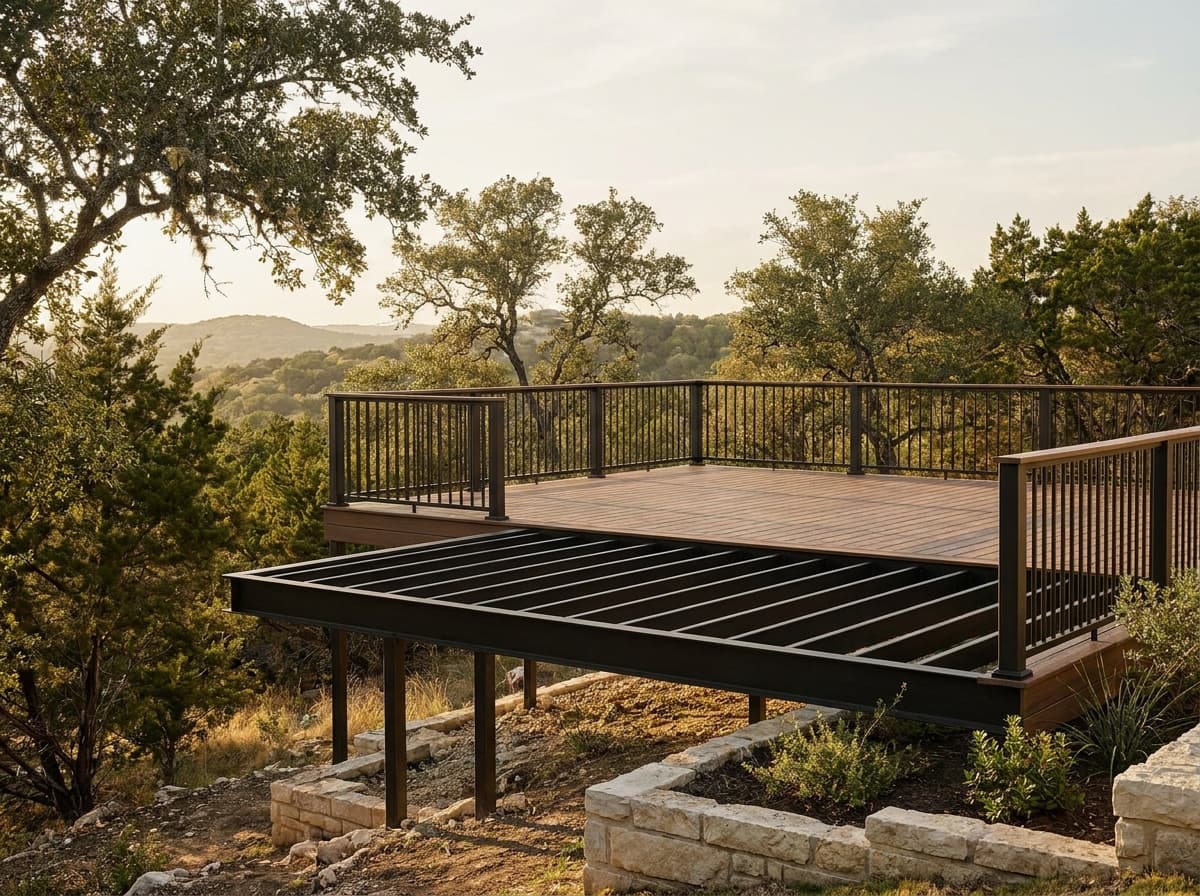
Steel-Framed Deck Cost in Central Texas (2026 Builder's Guide)
A steel-framed deck swaps the pressure-treated wood substructure for galvanized or coated steel joists and beams. It costs more than standard wood framing, and for some Central Texas homes it is exactly the right call: a straighter, longer-lasting, non-combustible base under your deck boards. The framing is a per-project premium quoted after a site visit, while the deck surface on top runs the same per-square-foot bands as any composite deck.
Where steel earns its keep is the Wildland-Urban Interface, the Hill Country edge where homes meet open wildland and wildfire is a genuine risk. A non-combustible steel frame is part of a fire-resistant deck assembly, and it also solves the sag, twist, and rot that wood framing eventually shows in this climate. This guide explains who actually needs steel, what goes into the cost, and how to think about the number.
Why steel framing, and who actually needs it
Steel framing answers three problems that wood cannot fully solve. The first is fire: steel is non-combustible, which matters for homes in the Wildland-Urban Interface where an ember shower is a real scenario. The second is permanence, since steel does not rot, twist, cup, or invite insects the way wood eventually does in Central Texas heat and moisture. The third is geometry, because steel holds longer spans dead-flat, which is valuable on elevated decks and sloped Hill Country lots.
That said, not every deck needs it. A low, flat, near-grade deck on a lot well away from wildland is served perfectly well by pressure-treated wood framing under composite boards. Steel is a considered upgrade for specific conditions, not a default, and an honest builder will tell you when your project is not one of them rather than sell you structure you do not need.
Steel and the Wildland-Urban Interface
The Wildland-Urban Interface is the zone where developed property meets undeveloped wildland, and much of the Hill Country around Austin and north of San Antonio sits in or near it. In a wildfire, decks are a known vulnerability, because a combustible structure can catch from radiant heat or wind-blown embers and carry fire to the house. Reducing that risk is the reason non-combustible construction keeps coming up in these communities.
A steel frame is one part of a fire-resistant deck assembly, not the whole answer on its own. The complete picture pairs the non-combustible substructure with a suitable decking surface and careful detailing to limit places where embers can lodge. Insurers and some jurisdictions increasingly favor non-combustible construction in higher-risk areas, so for a Hill Country home in the interface, steel framing can be as much about protection and insurability as about longevity.
What drives a steel-framed deck's cost
The steel premium comes from three places: the material itself, which costs more than pressure-treated lumber; the fabrication and connections, which are more exacting than wood carpentry; and the labor and engineering, particularly on elevated or long-span decks that require stamped structural plans. Because those variables swing widely from one lot to the next, the steel framing portion is quoted per project after we have seen the site rather than sold at a flat rate.
The surface on top is the more predictable half of the budget. Most steel-framed decks are finished with capped composite, which runs $52 to $72 per square foot installed depending on the line, and that figure behaves the same whether the frame beneath it is wood or steel. Thinking of the cost as a known surface number plus a site-specific framing premium is the clearest way to budget a steel-framed deck.
The surface still sets much of the price (the size math)
It helps to separate the two halves when you run the numbers. Take a 400-square-foot deck: the composite surface alone lands in the low-$20,000s for a value line, the mid-$20,000s for a mid line, and the high-$20,000s for a premium line, exactly as it would on wood framing. Steel does not change the boards; it changes the base underneath them.
On top of that surface figure sits the steel framing premium, which reflects your spans, deck height, and any fire-rating requirements. Railing, stairs at roughly $350 per step, and fascia at $29 to $49 per linear foot add as they would on any deck. The takeaway is that a steel-framed deck is not a different product priced from scratch; it is a familiar composite deck on a stronger, non-combustible base, and that base is the line item that varies most by site.
Texas-specific factors and when wood is the smarter spend
Central Texas conditions are exactly what make steel worth considering, and also what make it optional. Wildfire risk in the Hill Country interface, sloped and rocky lots that reward a dead-flat elevated frame, and the long-term toll our heat and moisture take on wood all push toward steel. The surface concerns are the same as any composite deck: darker boards run warmer in direct sun, so color choice affects barefoot comfort, and capped composite holds its color under our UV.
For a flat, low, near-grade deck on a lot outside the interface, standard pressure-treated framing under composite boards lasts well and saves you the steel premium. Steel becomes the smarter spend when fire rating, long or elevated spans, or a very long time horizon in the home justify it. Match the framing to the site and your plans, and put the savings toward a bigger deck or a better decking line when steel is not truly needed.
Common questions
The composite surface runs $52 to $72 per square foot installed depending on the line, and steel framing adds a per-project premium over wood framing, quoted after a site visit for span, height, and fire rating. A steel-framed deck sits above a comparable wood-framed one.
Most flat, low, near-grade decks do not. Steel makes sense in the Wildland-Urban Interface where wildfire is a risk, for elevated or long-span decks, and when you want a substructure that will not rot, twist, or sag. On an ordinary lot, wood framing under composite serves fine.
The steel frame is non-combustible, which is one part of a fire-resistant assembly for Wildland-Urban Interface homes. It works together with a suitable decking surface and careful detailing to limit ember catch points. Fire resistance comes from the whole assembly, not any single component.
The steel material, its fabrication and connections, and the labor and engineering all cost more than pressure-treated lumber, especially on elevated or long-span decks needing stamped plans. You are buying non-combustibility, straighter longer spans, and a base that outlasts the boards above it.