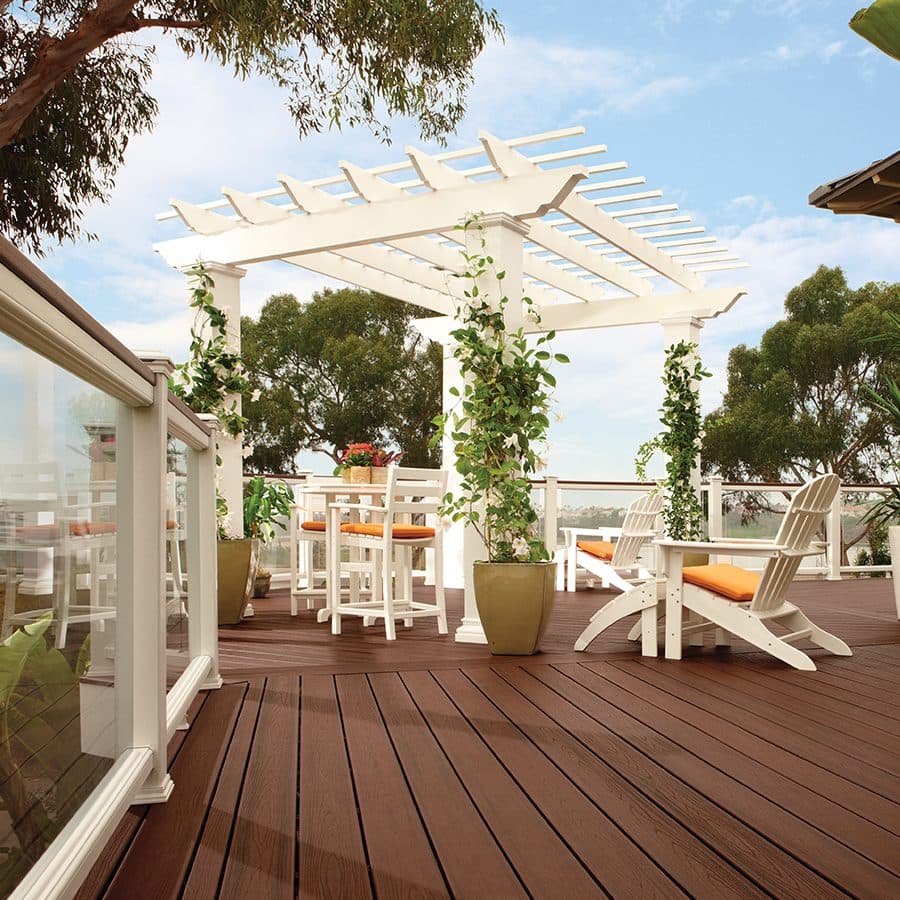
Trex Decking Cost in Central Texas (2026 Builder's Guide)
Trex is the composite decking most Central Texas homeowners name first, and for good reason: a capped board that holds its color through our summers and asks almost nothing of you afterward. Installed, Trex decking runs from about $52 to $80 per square foot depending on the line, with most homeowners landing in the high-$50s to low-$70s.
That per-square-foot figure covers the deck surface and its framing; railing, stairs, and any height are added on top. This guide walks the Trex lines from Enhance up to Signature, shows what a real deck costs once you do the math, and points out where in the range the extra dollars actually change what you get.
The Trex lines, briefly
Trex is not one product but a ladder of them, and the rung you choose sets most of your price. Enhance is the entry line, a capped composite in a focused set of core colors that gives you the durability and low upkeep Trex is known for at the lowest cost. Select adds a wider color range and a more refined finish, which is why it is the line most decks end up using.
Transcend and Lineage are the premium capped boards, with the richest grain and color depth, and Lineage carries technology engineered to run cooler in direct sun. Signature sits at the top, with the deepest colors and the most convincing hardwood look, and it is quoted per project rather than off a flat rate. Every line resists rot, insects, staining, and fading, so you are choosing look and feel more than basic performance.
What a real Trex deck costs (the size math)
Per-square-foot numbers only become useful when you multiply them out, so take a straightforward 400-square-foot deck. In Enhance that surface lands in the low-$20,000s, in Select the mid-$20,000s, in Transcend the high-$20,000s, and in Signature around $30,000 and up. Those figures cover the deck field and its framing on a simple, near-grade build.
What you add on top of that field is where totals climb. Railing runs by the linear foot, stairs add roughly $350 per step, fascia runs about $29 to $49 per linear foot, and a picture-frame border or hidden fasteners each add to the surface cost. A tall or elevated deck needs more framing underneath, which is why two 400-square-foot decks can carry very different prices. When you compare quotes, compare the whole scope, not just the per-foot rate.
What the installed price includes, and what adds to it
An installed Trex price covers the decking surface and the framing that carries it, fastened and finished as a complete deck. It does not automatically include everything a finished outdoor space might want, and that is where the options come in. Railing is priced separately by material and length, stairs add about $350 per step, skirting to close in the space below runs around $35 per square foot, and fascia to wrap the edges runs $29 to $49 per linear foot.
If your existing deck sits on sound framing, there is a lower-cost path worth knowing: resurfacing with new Trex boards over the existing substructure starts around $39 per square foot, well below a full rebuild. We inspect the framing before recommending it, because new boards over tired framing is a false economy. When the structure is solid, resurfacing gets you a new deck surface for meaningfully less.
Texas heat and your Trex color
Every capped composite, Trex included, warms up in direct afternoon sun, and darker boards warm up more. For a deck that sees barefoot traffic or dogs, that argues for a lighter color, or for the Lineage line, which is engineered to run cooler than standard boards. This is worth deciding early, because color is one of the few choices that affects comfort as much as looks.
Where Trex clearly wins the Texas climate is fade and wear. The polymer cap holds its color under relentless UV for decades rather than seasons, it will not rot or feed insects, and it never splinters the way an aging wood deck does. Those are the qualities you are paying for when you choose composite over wood, and they are exactly the qualities our summers test hardest.
Which Trex line is right for you
Enhance is the sensible choice when the budget needs to start lower, when the deck is simple or partly shaded, or when it serves a rental or a home you do not plan to keep for the long run. It still gives you Trex durability; it just does it in a tighter set of colors. Select is the line we point most homeowners toward, because its color range and finish suit a deck you will look at every day without pushing into premium pricing.
Transcend, Lineage, and Signature are for the showcase deck you intend to keep, where color depth, grain, and cooler-running boards justify the step up. If you plan to stay in the home for many years and the deck is the centerpiece of the backyard, the premium lines tend to feel worth it. If not, Select delivers most of the experience for less.
Common questions
About $52 to $80 per square foot installed depending on the line, with most homeowners in the high-$50s to low-$70s. Enhance is the value line, Select the popular middle, and Transcend, Lineage, and Signature the premium choices. Size, height, and railing move the final total.
Every capped Trex board holds its color well under our UV, so heat comfort is the real question. For barefoot decks, choose a lighter color or the Lineage line, which is engineered to run cooler underfoot. Any dark board, composite or wood, gets warm in direct afternoon sun.
Not up front. Pressure-treated wood starts around $40 per square foot installed and cedar around $50, while Trex starts in the low-$50s. Where Trex catches up is the years afterward, since it needs no staining or sealing and holds up with only an occasional wash.
If the substructure is sound, resurfacing with new Trex boards starts around $39 per square foot, well below a full rebuild. We inspect the framing first, because new boards over failing framing does not last. When the structure is solid, resurfacing is a smart way to a new surface.