Awning vs. Patio Cover vs. Pergola: Which Shade Structure Fits Your Home
August 5, 2026
If you are shading a patio, the first fork in the road is awning vs patio cover — and to choose well you have to start with what an awning actually is. An awning is a fabric or metal shade fixed to the wall of the house and cantilevered out over a door, window, or patio; a retractable awning extends and rolls back on an arm, while a fixed awning stays put. A patio cover, by contrast, is a permanent roofed structure carried on its own posts and footings. They solve the same problem — sun on a patio — in fundamentally different ways, and the right answer depends on your budget, whether you own or rent, and how much Central Texas weather you need the thing to survive.
We should say plainly up front: XPRT builds permanent structures — patio covers, pergolas, and louvered roofs — not awnings. That is not a knock on awnings; there are situations where an awning is genuinely the better call, and we will point them out honestly below. But for most homeowners planning a patio they intend to use for years, a permanent cover is the more durable and higher-value choice in this climate, and it is worth understanding exactly why before you spend on either.
What an awning is, and where it wins
An awning is a shade attached to the house rather than a freestanding structure. Fabric awnings stretch a canopy over a frame bolted to the wall; a retractable version rolls out on arms when you want shade and folds back against the house when you do not, and a fixed awning stays extended year-round. Metal awnings trade the adjustability for a more durable panel. In every case the house carries the load, so an awning needs no posts, no footings, and usually no permit.
That simplicity is exactly where awnings win. They are the least involved way to shade a patio, they install in a day, and a retractable one lets you choose sun or shade by the hour. For a renter who cannot build a permanent structure, for a small window or door that just needs cover, or for anyone who wants shade now without a construction project, an awning is a sensible, honest choice. Its strengths are low upfront outlay, reversibility, and speed — real advantages if those are what you need.
What a patio cover is, and why it lasts here
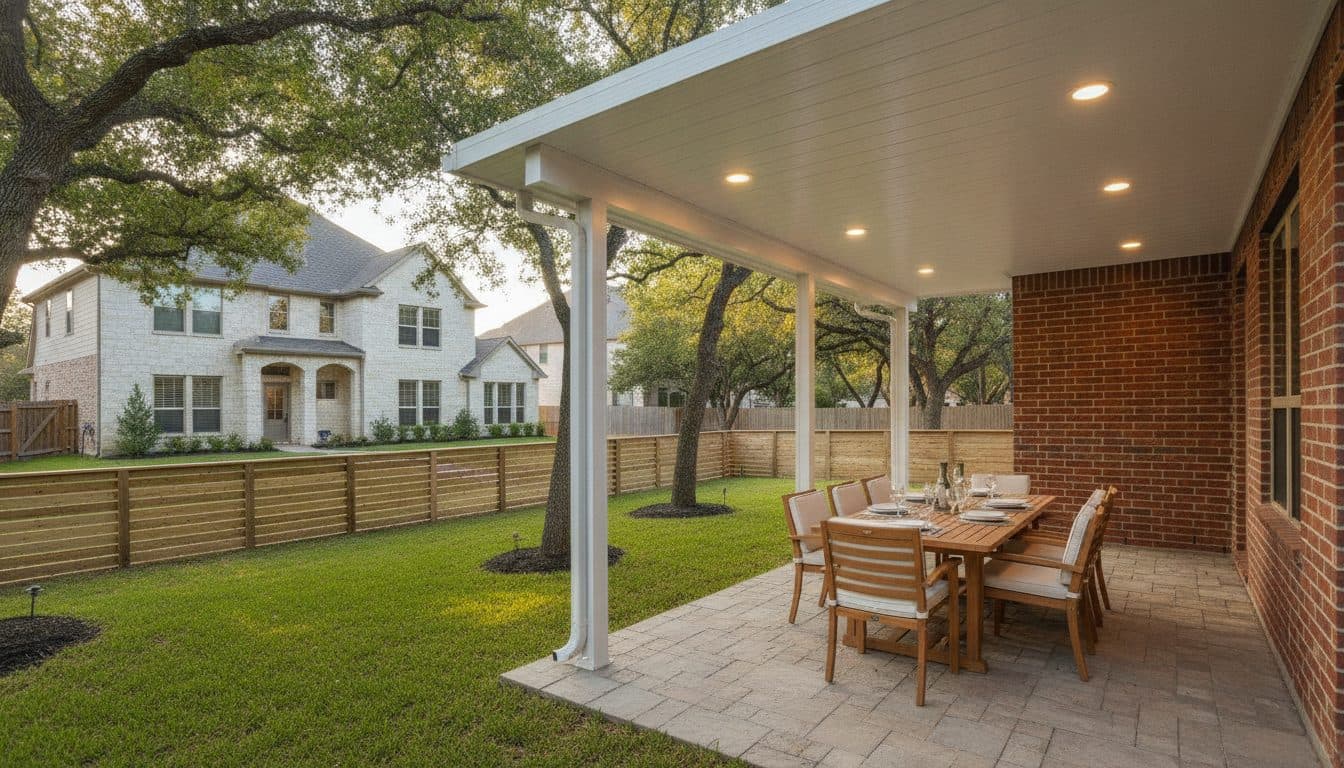
A patio cover is a permanent roof on its own structure: posts set in footings, beams, and a solid roof — insulated aluminum, a shingled or metal roof to match the house, or a finished ceiling with fans and lights. Because it stands on its own frame rather than hanging off the wall, it can cover a far larger area than an awning, span a full outdoor room, and carry a real ceiling with electrical, which an awning cannot. It reads as part of the house, not an attachment to it.
That permanence is the point in Central Texas. A patio cover built and anchored to code turns a patio into a year-round room — shade at the worst of the afternoon, a dry seat in a downpour, and a surface that shrugs off the sun instead of fading under it. It also adds lasting value to the home in a way a removable awning does not, because an appraiser and a buyer read a permitted, built structure as a genuine improvement.
Awning vs patio cover: durability in Central Texas wind and hail
The durability gap is where awning vs patio cover stops being a close call in this part of Texas. A fabric awning is, in the end, cloth on an arm: it fades in the relentless UV, it can tear or be shredded by hail, and it has to be retracted ahead of any real wind or it risks being bent or torn loose. Even a metal awning, cantilevered off the wall, is vulnerable at its single line of attachment when a storm hits. In a region that sees hail and hard gusts most years, that is a structure you are constantly protecting.
A permanent cover is engineered for exactly those loads. Its posts and footings are sized for local wind, and a solid metal or shingled roof takes a hail impact that would destroy a canopy. You do not retract it, watch the forecast for it, or replace its fabric every few years. Over a decade of Central Texas sun and storms, the permanent structure is the one still standing and still looking right — the awning is the one you will have serviced, re-covered, or replaced.
Where a louvered pergola fits
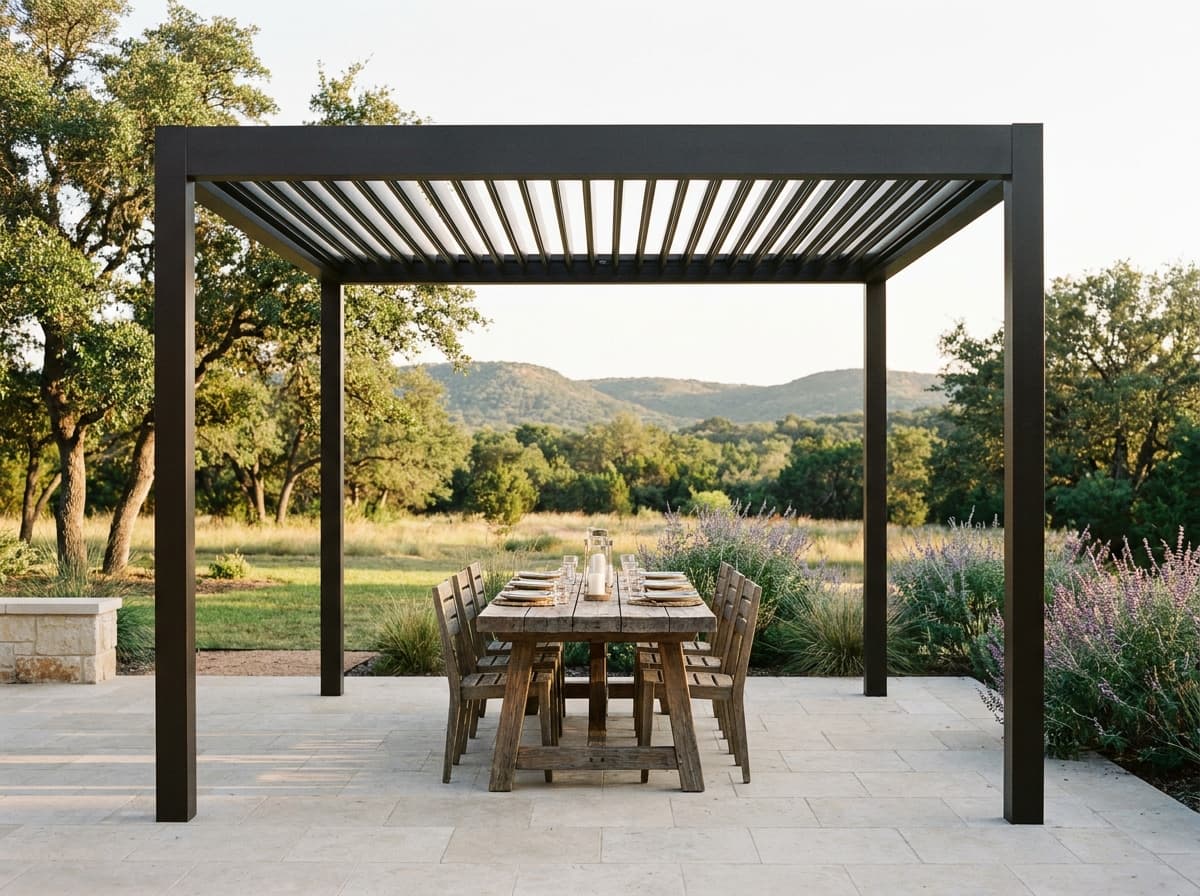
There is a third option that captures the awning's flexibility without its fragility: the motorized louvered pergola. Its roof is a set of aluminum blades that rotate from fully open to fully closed, so one permanent structure gives you open sky, filtered shade, or a sealed roof that sheds rain — the adjustability people like in a retractable awning, built into a structure engineered to stay put. As the Preferred StruXure Dealer for Austin, we install these as permitted, anchored louvered pergolas with the drainage done properly.
Against an awning, the louvered roof wins on durability and coverage while keeping the day-to-day flexibility; against a fixed patio cover, it trades some cost for the ability to open the roof to the sky when you want sun. If you are weighing an adjustable roof against a solid one, our louvered versus fixed pergola comparison lays out the trade-offs in detail.
Cost, permits, and value over time
On upfront price the order is clear: an awning costs the least, a solid patio cover more, and a motorized louvered roof the most, because each step adds structure, engineering, and — in the louvered case — a mechanism. But upfront price is only half the math. An awning's fabric is a recurring expense, fading and needing replacement on a cycle, while a permanent cover is largely a one-time build that adds lasting value to the home.
Permitting tracks the same line. An awning attached to the wall usually needs no permit; a permanent, footed cover or pergola typically does in the Austin and San Antonio area, and we pull it with the stamped engineering as part of the build rather than leaving it to you. For honest, rounded numbers on the permanent side, our patio cover cost guide breaks down what drives the figure, from span and roof type to whether the cover attaches to the house.
How to choose, and when an awning is the answer
Match the structure to how long you will keep it and how much weather you need it to beat. If you rent, need shade over a single window or door, want the lowest possible outlay, or want something temporary and reversible, an awning is the honest answer, and we will tell you so rather than sell you a structure you do not need. A retractable awning over a small patio, for a homeowner who wants sun-or-shade on demand and does not want to build, is a perfectly good outcome.
If you own your home and want a patio you will use for years — a real outdoor room that survives the sun, the hail, and the wind, adds value, and needs no seasonal babysitting — a permanent patio cover or a louvered pergola is the better investment, and it is what we build. When you want a ballpark for a permanent cover on your patio, our instant estimate gives you a range in a few minutes.
Common questions
An awning is a fabric or metal shade fixed to the wall of a house and extended out over a door, window, or patio. A retractable awning rolls out and folds back on arms so you can choose sun or shade; a fixed awning stays extended. Because it hangs off the wall rather than standing on its own posts, an awning needs no footings and usually no permit, which makes it the quickest, least involved way to add shade.
For most Central Texas homeowners planning a patio they will use for years, a permanent patio cover is the more durable and higher-value choice. A fabric awning fades in the UV and is vulnerable to hail and wind, while a footed, engineered cover is built for those loads and adds lasting value to the home. An awning wins when you rent, need only a small area shaded, or want the lowest upfront outlay.
No. XPRT builds permanent structures — patio covers, pergolas, and motorized louvered roofs — not awnings. If an awning is genuinely the right call for your situation, such as a rental or a small window that just needs cover, we will tell you honestly. For a patio you plan to use for years in this climate, we build the permanent cover or louvered roof that stands up to the sun, hail, and wind.
Not especially well. A fabric awning fades under constant UV and can tear or be shredded by hail, and it has to be retracted ahead of any strong wind to avoid damage. Even a metal awning is vulnerable at its single wall attachment in a storm. A permanent patio cover or louvered pergola, with posts and footings engineered for local wind and a solid roof that takes a hail hit, is built to stay put through Central Texas weather.