Backyard Shade Ideas That Actually Beat the Texas Sun
July 15, 2026
Most patio shade ideas you will find online start and end with an umbrella or a shade sail, which is a bit like treating a broken bone with a bandage. Those things have their place, but in Central Texas, where a west-facing patio can hold heat from three in the afternoon until sundown, a stopgap you have to drag around and put away before a storm is not a real answer. The backyard shade that actually changes how you live outside is permanent and architectural.
This guide treats umbrellas and sails honestly as what they are — cheap, movable, temporary — and then spends its time on the shade that lasts: pergolas, patio covers, and motorized louvered roofs, engineered and anchored for Texas heat and wind. Just as important, it tells you how much shade each option actually delivers and at what time of day, because a structure that shades well at noon can leave you fully exposed to the low afternoon sun that does the real damage.
Why Austin backyards need permanent shade, not just umbrellas
The Austin sun is not a gentle presence. From late spring through October, direct exposure on an unshaded patio pushes surface temperatures and the air above them well past comfortable, and it fades furniture, cracks finishes, and drives everyone back indoors by mid-afternoon. An umbrella shades a table; it does not shade a room, and it becomes a projectile in the gusts that come ahead of a Hill Country storm.
Permanent shade solves the whole space at once. A fixed structure over the patio cools the area beneath it, protects your furniture and finishes, and — because it is engineered and anchored — stays put through wind and hail. It extends your usable outdoor season by months and adds real living square footage to the house, buying years of a backyard you actually use rather than avoid.
Patio shade ideas that last: pergolas, covers, louvered roofs, sails and screens
Start with the open end of the spectrum. A wood or steel pergola filters sun into pattern shade and frames the space, and with tighter slats, a retractable canopy, or a shade sail stretched across it, it delivers more cover than open rafters alone. It keeps the patio bright and breezy, which many homeowners prefer, and it is the most affordable permanent structure.
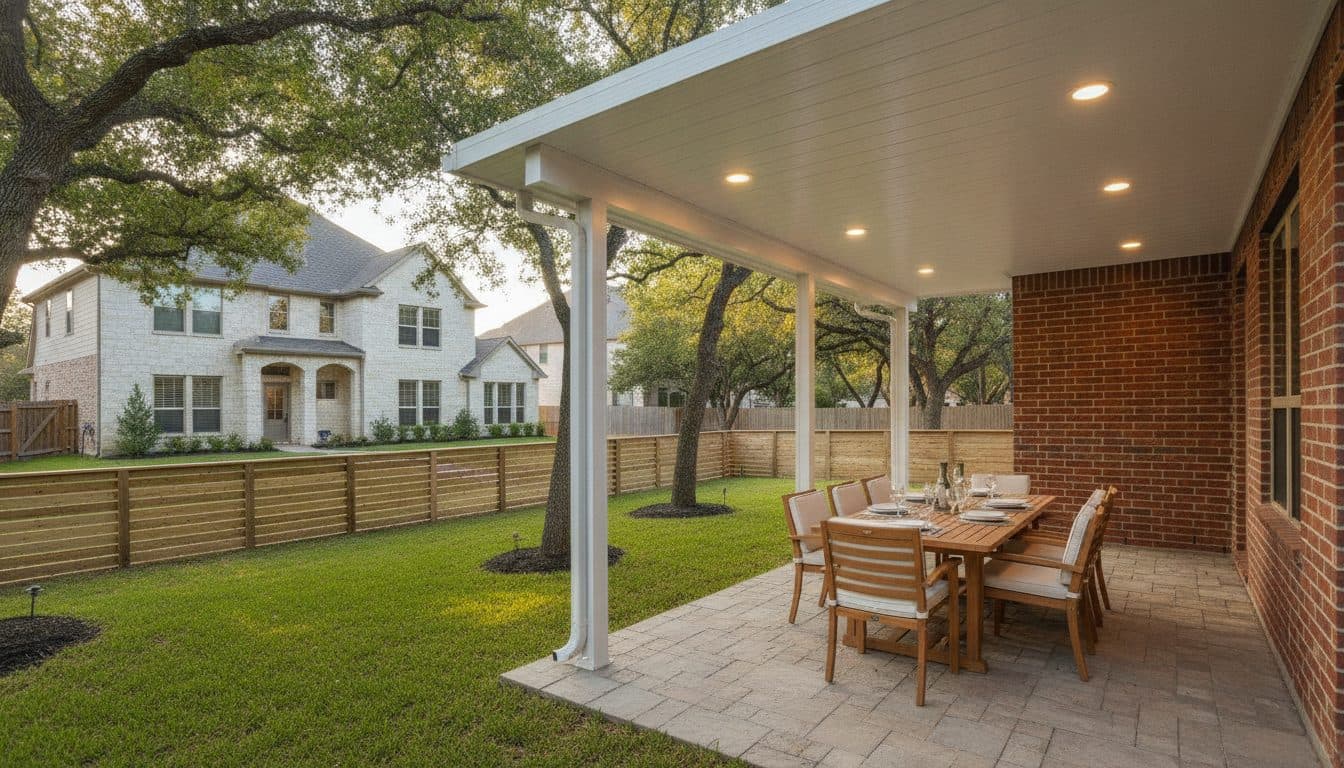
At the solid end, a patio cover puts a real roof over the space — insulated aluminum or site-built wood — for dry, dependable shade in any weather. In the middle sits the motorized louvered roof, which opens and closes on demand. Vertical shade matters too: motorized or fixed screens on the sun-facing side block the low, direct light that a roof overhead cannot, which is often the difference between comfortable and unusable late in the day.
How much shade each option delivers, and when in the day
Overhead shade and afternoon shade are two different problems, and this is where most shade advice falls short. A solid patio cover or a closed louvered roof blocks close to all of the sun coming from above, so it performs from mid-morning through early afternoon when the sun is high. An open pergola without a canopy blocks perhaps a third to half of overhead sun depending on slat spacing — pleasant dappling, not full protection.
The catch is the late afternoon. As the sun drops toward the western horizon, its light comes in almost horizontally, sliding right under any roof and straight into your eyes and furniture. No overhead structure alone solves this. That is why a west- or south-facing patio usually needs a vertical element — a screen, a drop shade, or plantings — paired with the roof, so the space stays shaded through the hours when Texas sun is at its most punishing.
Adjustable shade: how motorized louvered roofs open and close
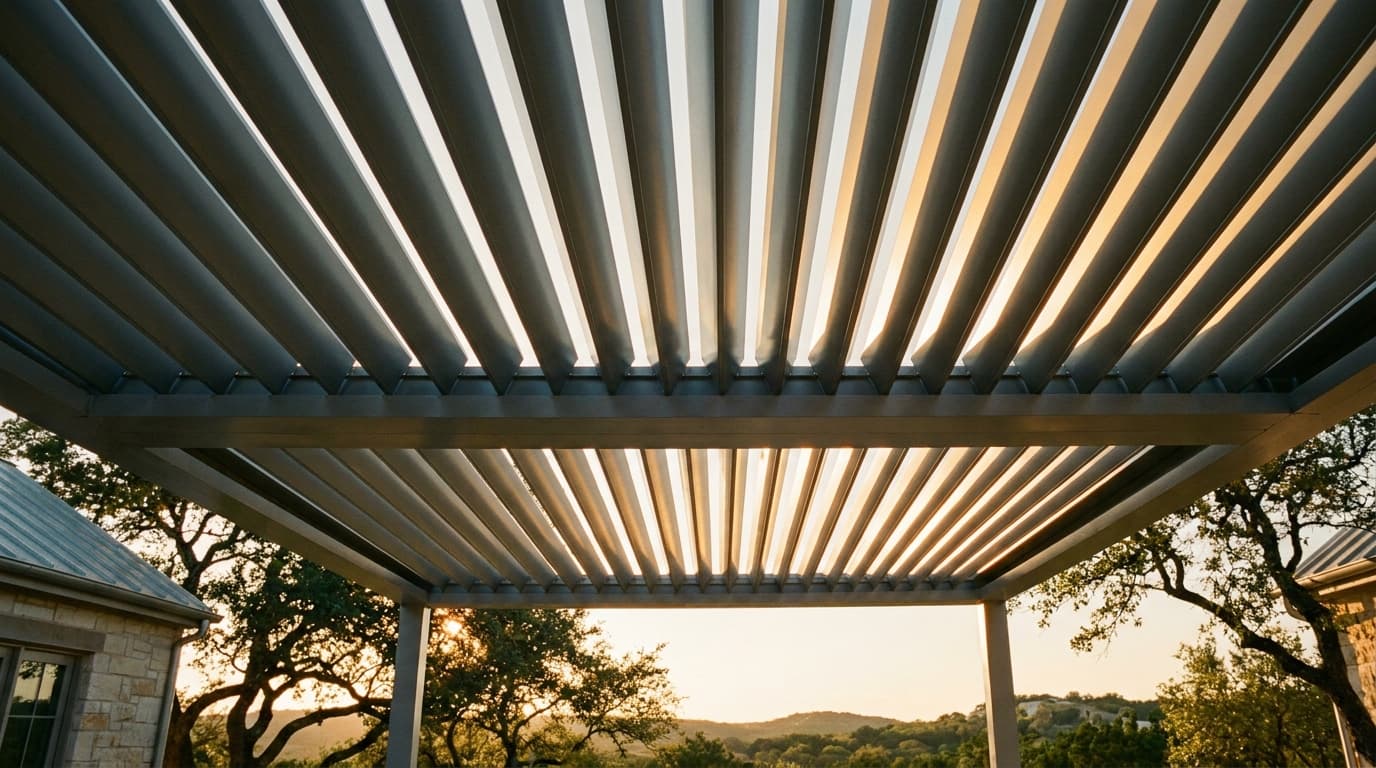
A motorized louvered roof is the most flexible shade there is. Its aluminum blades rotate from fully open to fully closed on a switch, an app, or automatically via rain and sun sensors. Open, you get full sky and breeze on a mild morning; angled, you get filtered shade that still lets heat escape; closed, you get a sealed roof that blocks the sun entirely and sheds rain into gutters built into the frame.
That range is why the louvered roof answers the afternoon-sun problem better than a fixed cover. You can tilt the blades to cut the low western light while still venting hot air, then open them back up once the sun is down. As the Preferred StruXure Dealer for Austin, we install these with the engineering, drainage, and controls done properly, so the flexibility holds up over years of daily use.
Matching shade to west- and south-facing yards
Orientation should drive the design, and it rarely does in a generic plan. A north-facing patio gets the least direct sun and can often be served well by an open pergola, and an east-facing patio bakes in the morning and cools by afternoon. The hard cases are west- and south-facing yards, which take the full brunt of the hottest, lowest sun of the day and need the most protection.
For those exposures we design the roof and the vertical shade together. A solid or louvered roof handles the overhead sun, while motorized screens or a drop shade on the west and south sides intercept the low-angle light before it reaches the seating. Getting the geometry right — the depth of the cover, the height of the posts, the placement of the screens — is the part a walk-through of your actual yard settles that a catalog cannot.
Materials and finishes that stay cooler in direct Texas sun
Not all shade materials perform the same under this sun. Insulated aluminum panels have a foam core that cuts the radiant heat passing through the roof, so the space underneath stays noticeably cooler than it would under a bare metal or wood roof. A baked-on, light-toned finish reflects more heat than a dark one and never needs sealing to hold its color.
Wood shades well and looks warm, but the wood itself lives in the same sun that ages a deck and needs re-sealing on a cycle. Powder-coated aluminum and engineered steel resist that UV without the upkeep. Whatever the material, lighter finishes run cooler to the touch and radiate less heat back at you — a small choice that pays off every afternoon from June through September.
Planning permanent shade: attachment, permits and professional install
Permanent shade is a building project, not a purchase. How the structure meets the house — attached to the existing roofline, fascia-mounted, or freestanding out in the yard — shapes the whole design and depends on your roof, walls, and where the sun falls. Underneath, every option is an engineered structure with footings sized for Central Texas clay and connections detailed for local wind, the part that decides whether it rides out a storm.
A permanent, footed, and often wired structure typically requires a permit, and many neighborhoods add HOA review. We handle the stamped engineering, the permit, and the install as one accountable crew. If you want to understand the investment before you commit, our patio cover cost guide lays out the ranges honestly, and the instant estimate tool will size a ballpark for your specific space.
Common questions
It depends on how much sun your patio takes and how much flexibility you want. A solid patio cover or a motorized louvered roof gives the most reliable overhead shade, while a pergola offers lighter, dappled cover at a lower cost. West- and south-facing patios usually need a roof plus a vertical screen to block the low afternoon sun.
They help as movable, low-cost shade, but they are stopgaps rather than solutions. Umbrellas shade only a small area and become hazards in the gusts before a storm, and fabric sails have to be taken down ahead of high wind and hail. For a patio you use through the summer, a permanent engineered structure is the dependable answer.
An open pergola blocks roughly a third to half of overhead sun depending on slat spacing, casting pattern shade rather than full cover, while a solid or closed louvered roof blocks nearly all of it. Adding a canopy, tighter slats, or a shade sail to a pergola increases its coverage, but a solid roof remains the choice for dependable, all-weather shade.
Most likely the heat is coming from the low afternoon sun sliding in horizontally under the roof, not from directly above. An overhead cover cannot stop side-angle light, so a west- or south-facing patio needs a vertical element — a motorized screen, drop shade, or plantings — to block it. Insulated roof panels and lighter finishes also keep the space cooler than bare or dark materials.