Backyard Fire Pit and Fireplace Ideas for Year-Round Texas Evenings
July 15, 2026
The best backyard fire pit ideas are not really about the fire — they are about what the fire pulls people toward. A well-placed fire feature is the anchor of an outdoor room, the reason a Central Texas backyard stays in use from October through spring instead of going dark the moment the patio furniture cools off. Whether you want a low pit to gather around or a tall fireplace that commands one end of the patio comes down to how you use the space.
Both are real masonry structures when they are built to last, not metal bowls dropped on the grass, and both come with decisions worth getting right up front: gas or wood, built-in or freestanding, and which materials weather our sun and clay. This guide walks through those choices, the safety clearances and gas-line planning that DIY listicles skip, and how to tie a fire feature into the rest of the yard so it earns its keep year-round.
Fire pit vs. outdoor fireplace: which fits your space
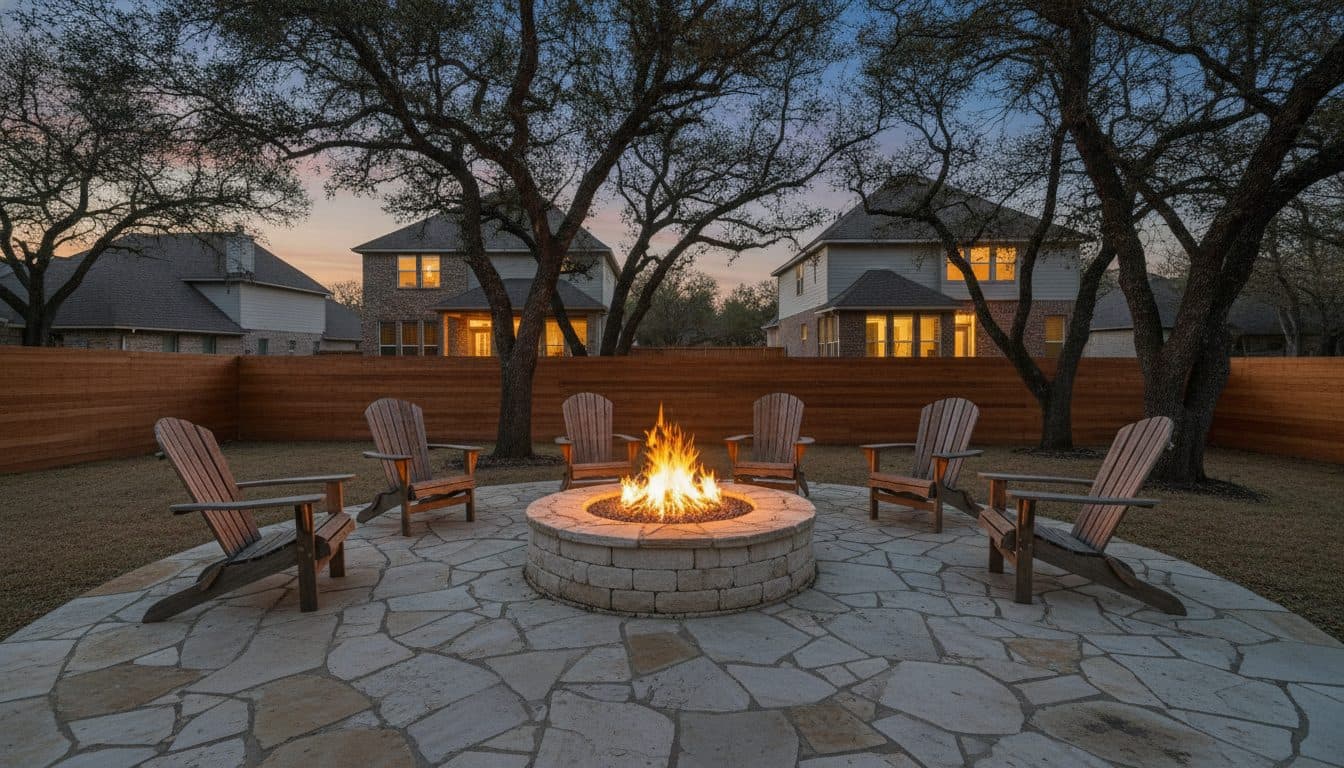
A firepit is social and open — everyone sits around it, it throws heat in every direction, and it suits a casual, pull-the-chairs-into-a-circle patio. It has a smaller footprint and a lower cost of entry than a fireplace, and it keeps sightlines low so conversation carries across it. For most backyards, the pit is the natural starting point and often the only fire feature a family needs.
An outdoor fireplace is architectural and directional. A tall masonry structure with a firebox and hearth, it anchors one edge of the patio, throws heat and light outward, gives the space a genuine focal point, and doubles as a windbreak on a breezy Hill Country evening. It asks for more room and more budget than a pit, which is why larger projects sometimes include both — a fireplace to define the space and a pit for gathering — in different zones of the yard.
Gas vs. wood-burning fire features, and Austin burn considerations
Wood gives you the fire people picture: the crackle, the woodsmoke smell, the ritual of building and tending it. The trade is the work around it — storing dry wood, clearing ash, managing smoke drift, and keeping generous clearances from anything combustible. On the right lot, with room to breathe, a wood fire is hard to beat for atmosphere.
Gas gives you flame at the turn of a switch, precise control, and no cleanup, which is why it is often the practical choice — and in Central Texas it is frequently the only permitted one. Many denser Austin-area neighborhoods restrict open wood fires, and the summer burn bans that come with our dry spells can rule them out for months at a time. A gas fire feature sidesteps that, running on a properly sized line you light and shut off on demand. Neither is better; they are different experiences, and some homeowners build gas for convenience with a separate wood pit for the nights they want the real thing.
Built-in vs. freestanding backyard fire pit ideas
Built-in and freestanding are two very different commitments. A built-in fire feature is masonry, set on a proper base and integrated into the patio — often ringed by seat walls or tied to an adjoining kitchen — so it reads as part of the architecture and stays put for decades. It can burn wood or run on gas, and because it is engineered into the space, it anchors a design rather than sitting on top of one.
Freestanding bowls, tables, and portable pits are the flexible, lower-cost end of the backyard fire pit ideas people usually start with. They move where you want them and require no construction, which is genuinely useful for a rented home or an undecided layout. The honest limitation is that a portable unit is furniture — it does not deliver the heat, permanence, or designed-in feel of a built pit, and it will not anchor an outdoor room the way a masonry feature does.
Materials: stone, concrete, steel and how they weather
Most built fire features are faced in natural or manufactured stone or a rendered stucco, chosen to tie into the house and any adjoining seat walls or kitchen. Whatever the face, the structure below the surface has to be built for our expansive clay — a footing that resists the seasonal shrink and swell that otherwise cracks understructured masonry. Stone and stucco weather slowly and gracefully here when the base is right.
Concrete opens a more modern direction — board-formed or smooth-poured surrounds that read clean and contemporary — while steel shows up as burners, bowls, and weathering-steel surrounds that develop a rusted patina by design. Each ages differently: quality masonry and stone are the longest-lived, concrete is durable but can show hairline movement, and steel trades a maintenance-free patina for the industrial look some homeowners want. We match the material to the style of the home and the way the feature will be used.
Integrating fire features with patios, seating and outdoor kitchens
A fire feature works best when it is planned with the floor and the seating around it, not added afterward. On a paver or concrete patio, we can set the pit or fireplace as the visual center and wrap it with low seat walls that provide built-in seating and define the edges of the room — turning a flat patio into a space with a clear purpose and a place for everyone to land.
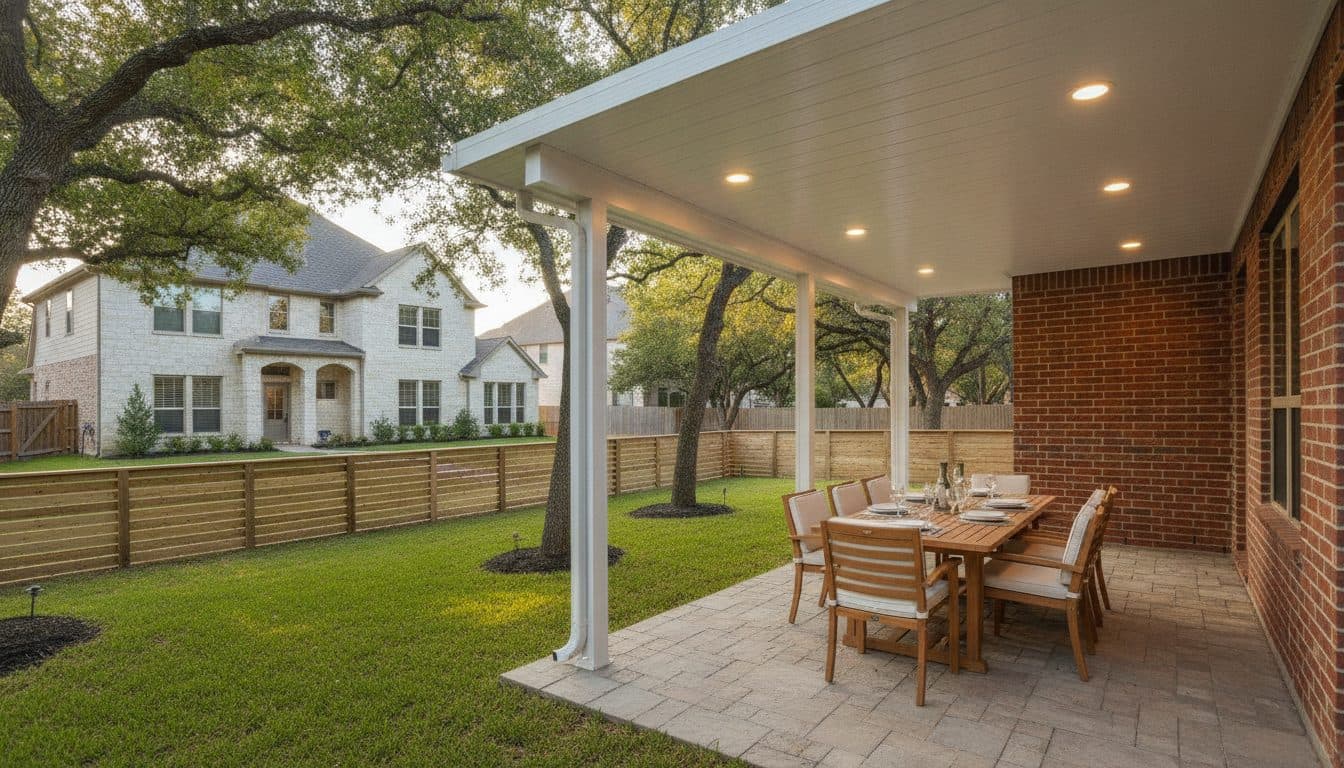
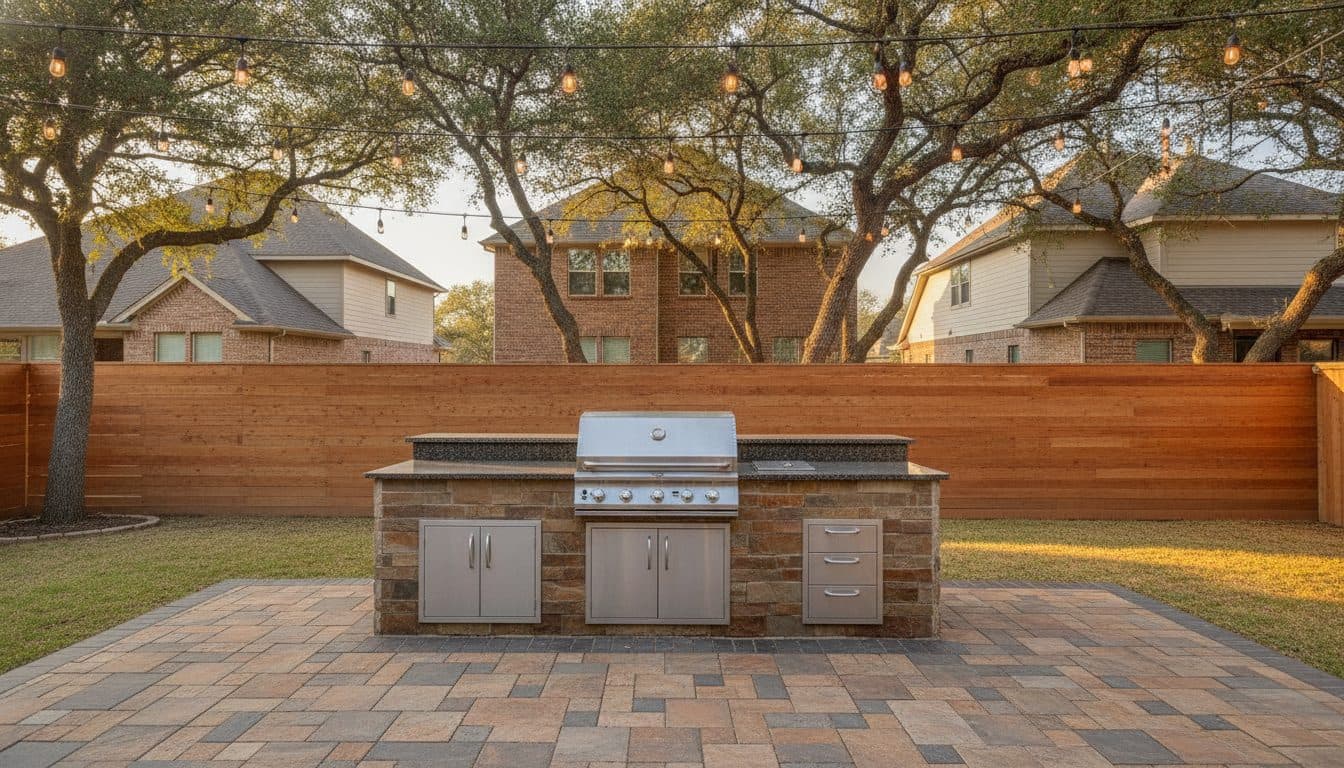
The fire feature also pairs naturally with the rest of an outdoor living build. A fireplace and an outdoor kitchen can share a masonry wall or a material palette so the cooking and gathering zones read as one room, while a pit sits comfortably just off a dining area. Where a feature goes under or near a covered structure, the clearances and, for wood, the venting have to be engineered in — which is exactly why the fire and any cover over it should be designed together.
Safety, clearances and a design that anchors the yard year-round
Fire is the one place in a backyard where cutting corners is genuinely unsafe, so the clearances are not optional. Both wood and gas features need required distances from the house, from any cover, and from combustible surfaces; the area right around the flame has to be non-combustible; and gas features require a properly sized, permitted line with safe shutoffs. Open flame under a low or combustible structure only works with engineered clearances and, for wood, a flue that carries smoke safely above the cover — never as an afterthought.
Get the safety and the siting right and the payoff is a backyard that works most of the year. We orient a fire feature to the prevailing wind and to the sightlines from where people actually sit, layer in lighting so the space reads after dark, and tie it to the patio, seating, and shade so it anchors a true outdoor room rather than standing alone. If you are picturing where a pit or fireplace could sit in your yard, you can book a design consultation to walk it on site.
Common questions
A firepit is social, compact, and lower cost — everyone sits around it and it warms in all directions. A fireplace is a taller architectural focal point that anchors one edge of the patio, directs heat outward, and blocks some wind, at the cost of more room and budget. Many larger yards include both in different zones.
It depends on your rules and the experience you want. Wood delivers the classic crackle and smell but means storing fuel, clearing ash, and managing smoke, and it is restricted in many denser neighborhoods and during dry-season burn bans. Gas lights instantly, offers precise control, leaves no mess, and is often the only permitted option locally.
Sometimes, but only with the right clearances and, for wood, a flue that carries smoke safely above the cover. Open flame and a low or combustible structure do not mix without engineering the clearances, which is why the fire feature and any structure over it should be designed together rather than added separately.
Often, yes, especially gas features, which require a permitted, code-compliant gas line, and masonry fireplaces with a chimney. Requirements vary by jurisdiction and even by neighborhood association, and burn bans can restrict wood fires seasonally. Confirming what your location allows and pulling the needed permits is part of building the feature properly.